How NRIs Can Invest in Global Markets in GIFT City: Opportunities & Risks
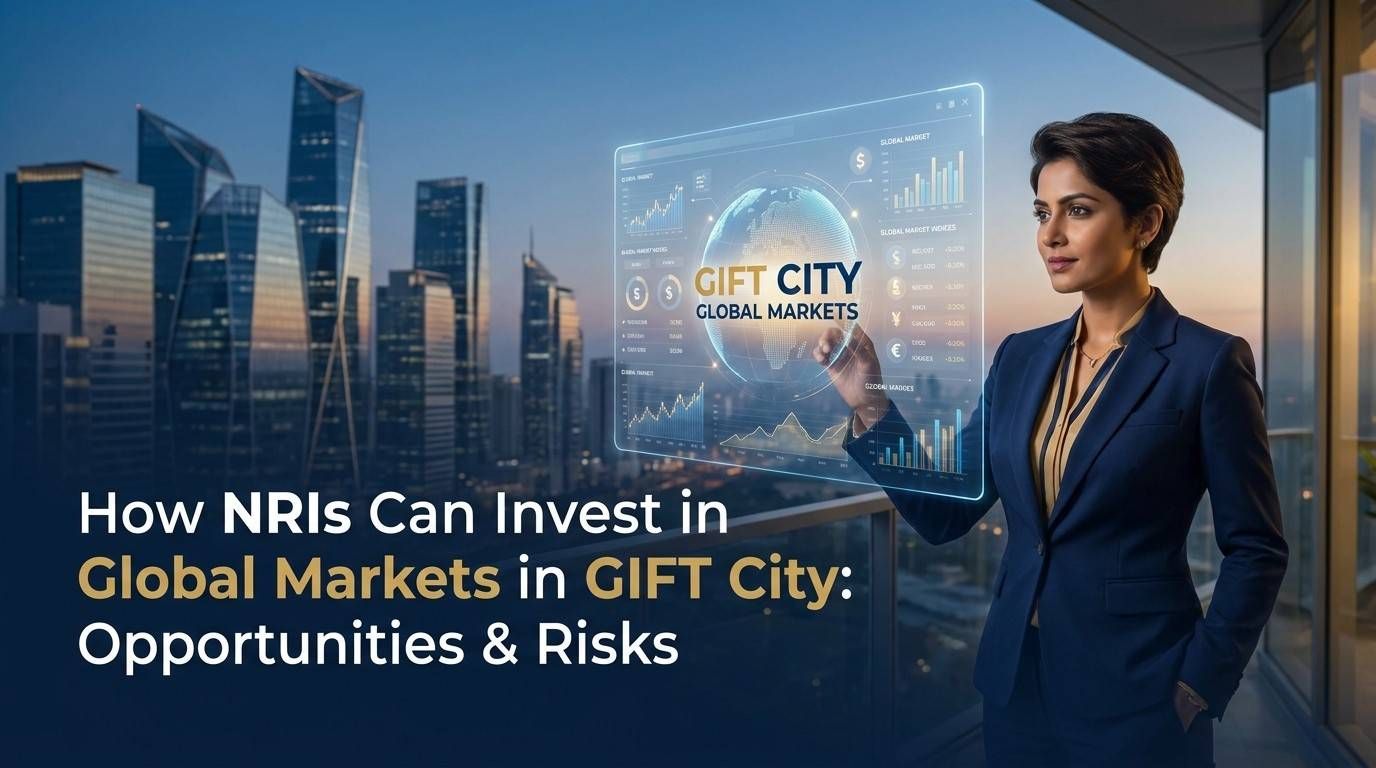
Table of Content
- Introduction
- Why Should NRIs Consider Investing Through GIFT City?
- Where can NRIs invest in GIFT City?
- Equities and ETFs
- GIFT City mutual funds
- Bonds and fixed income
- USD-Denominated Insurance
- Alternative Investment Funds (AIFs)
- Benefits of Investing in Global Markets
- GIFT City vs Traditional Overseas Investing
- Risks Investors Should Consider
- How Can NRIs Start Investing Through GIFT City?
- Conclusion
Introduction
You live abroad, and all you invest in is building a lifestyle.
When it comes to investing, NRIs’ portfolios often remain concentrated in a single market or geography. People assume NRI investing is limited to either stocks or mutual funds.
But lately, GIFT City has emerged as an avenue both compliant and tax-efficient for NRIs.
So what exactly changes when you invest through GIFT City instead of the usual NRI channels?
Why Should NRIs Consider Investing Through GIFT City?
GIFT City is India's first International Financial Services Centre (IFSC), located in Gandhinagar, Gujarat, and regulated by a single unified authority — the International Financial Services Centres Authority (IFSCA).
The core idea of GIFT City is to "onshore the offshore." In plain terms, it gives you the regulatory comfort of a global hub like Singapore or Dubai, but with a direct line into India's growth story.
But “Why should NRIs consider GIFT City?”
Well, for NRIs, investing overseas brings several issues like currency, tax rules, etc., which GIFT City solves.
No currency conversion loss
Since GIFT City allows foreign currency accounts, investors can invest only in USD without converting into rupees.
Extended trading windows
Some products on the IFSC exchanges run for roughly 22 hours a day. It means you can invest from any time zone.
IFSCA-Regulated
IFSCA oversees banking, capital markets, insurance, and fund management in GIFT City.
Simplified onboarding
Digital KYC and GIFT City account opening are quite simplified here, eliminating the need to be physically present in India to get started.
Where can NRIs invest in GIFT City?
For NRIs, GIFT City isn't a single platform, but a marketplace of foreign-currency investment options, accessible through the IFSC stock exchanges, India INX and NSE IX, and various Fund Management Entities.
Here are the options you, as an NRI, can access in GIFT City:
Equities and ETFs
- Includes the Indian Equity Market and global stocks (via MFs/AIFs), Exchange-traded funds (ETFs)
- Indian Mutual Funds (taxable for NRIs)
- Direct Equities, tradable in foreign currency through the IFSC exchanges.
One can also invest in US stocks and global indices via Anand Rathi’s Global Access Platform.
GIFT City mutual funds
These are offshore funds run by AMCs operating out of the IFSC. They invest in foreign equities, debt, commodities, derivatives, or a blend of global and Indian assets.
In GIFT City, NRI investors can invest in USD-denominated inbound mutual funds with a minimum $500 (eg; Tata India Dynamic Equity Fund) and $5000 (eg; Sundaram India Mid Cap GIFT Fund).
Bonds and fixed income
It includes Government-backed securities, Corporate bonds, and Structured debt products issued within the IFSC, along with rupee-denominated Masala Bonds and green bonds.
Do check with the IFSCA broker before investing.
USD-Denominated Insurance
GIFT City provides tailored products to NRIs, including dollar-denominated term life, health, and annuity plans.
Alternative Investment Funds (AIFs)
The umbrella of AIF includes Cat 1, Cat 2, and Cat 3 funds. They cover non-traditional assets like;
- Private equity
- Startups
- Real estate
- Infrastructure
- Hedge-fund-style strategies, typically positioned for HNI investors with a longer horizon.
Benefits of Investing in Global Markets
GIFT City offers eligible NRIs a regulated gateway to access global investment opportunities while simplifying cross-border investing. Here are some of the key benefits:
1. Access to Global Investment Opportunities
Invest in international equities, ETFs, bonds, mutual funds, AIFs, insurance, and other global investment products through a single financial ecosystem.
2. Foreign Currency Investing
Hold and invest in multiple foreign currencies to align investments with your global income and financial goals.
3. Simplified Cross-Border Banking
Access foreign currency accounts, international remittances, and digital banking solutions designed for cross-border financial transactions.
4. International Trading Platform
Trade across global markets through IFSC exchanges with extended trading hours, making it easier for NRIs in different time zones to participate.
5. Access to Alternative Investments
Explore investment opportunities in Alternative Investment Funds (AIFs), private equity, infrastructure, real estate, and other private market assets available through the IFSCA-registered providers.
6. Potential Tax Efficiency
Depending on the investment product and applicable tax laws, NRIs may benefit from lower capital gains tax or tax incentives as well. Post-tax implications could apply when investors take back money to their home country.
7. Lower Transaction Costs
In GIFT City, there is “No GST, Capital Gains Tax, Securities Transaction Tax (STT), nor Commodities Transaction Tax (CTT).”
GIFT City vs Traditional Overseas Investing
Before GIFT City, NRIs had traditional methods to invest in overseas/global markets with limited options.
However, with GIFT, investors got several options on the plate.
| GIFT City (IFSC) | Traditional Overseas Investing | |
| Investment Options | Wide range of global investment products in one ecosystem | Depends on the broker and market |
| Trading Hours | Up to 22-hour trading (for GIFT Nifty) | Limited to local market hours |
| Tax Efficiency | Certain IFSC investments may offer tax benefits* | Varies by country and tax laws |
| Investment Platform | Single IFSC ecosystem | Multiple brokers/platforms |
Risks Investors Should Consider
While GIFT City offers access to global investment opportunities, investors should evaluate the following risks before investing:
High Minimum Investment:
Some products have relatively high entry requirements, making them suitable primarily for HNIs. For eg, the minimum investment limit for AIFs is ₹150,000.
Global Market Risk:
For certain products (global stocks), returns are influenced by the performance and volatility of international markets.
Currency Risk:
Even with tax benefits available, exchange rate fluctuations could still impact investment returns.
Cross-Border Taxation:
Tax implications may vary based on your country of tax residence and applicable regulations.
Liquidity constraints:
As a relatively new financial hub, certain products may have lower liquidity or fewer investment options than established global markets.
How Can NRIs Start Investing Through GIFT City?
NRIs can invest in GIFT City products like stocks, global mutual funds, insurance, PMS, or AIFs through this process;
Step 1: Open a foreign currency account with a bank operating an IFSC Banking Unit in GIFT City.
Step 2: Get onboarded with an IFSCA-registered broker to trade on India INX or NSE IX, or connect with an IFSCA-authorised fund manager for mutual funds, PMS, or AIFs.
Step 3: Complete KYC and compliance formalities, typically supported by digital verification so you don't need to be physically present in India.
Step 4: Transfer funds in foreign currency into your GIFT City account.
Step 5: Choose your investment products (equities, ETFs, mutual funds, bonds, PMS, or AIFs) based on your goals and risk appetite.
(Note: Do consult a tax advisor, particularly if you're a resident in a country with global taxation rules, before finalising your allocation.)
Conclusion
For NRIs, investing in global markets through GIFT City is the cherry on the cake. Fewer currency conversions, one regulatory umbrella instead of several, and a genuinely wide product shelf with taxation benefits.
Agreed that GIFT City has created this new gateway, but any decision should be filtered through your goals, risk appetite, and portfolio needs.
Likewise, for high-capital products like AIF or PMS, evaluating the investment strategy, currency exposure, tax implications, and portfolio fit remains essential before investing.
Frequently Asked Questions
What are the taxation rules for NRIs in GIFT City?
Non-resident Indians don’t have to pay no STT, CTT, or GST on GIFT City-based transactions.
Here are the other tax rules applicable for NRIs in GIFT:
- Dividend Income - Taxed at a concessional rate of 10%
- Capital Gains - On certain IFSC-listed shares and derivatives, tax may be as low as 9%.
Can NRIs invest in US stocks through GIFT City?
Yes. Eligible NRIs can invest in US stocks and other global securities through GIFT City via Anand Rathi’s Global Access Platform.
Is there a tax holiday available for NRIs in GIFT City?
Certain IFSC-registered entities in GIFT City can get a tax holiday of 10 years out of a 15-year block.
Can Non-resident Indians make investments in USD in GIFT City?
GIFT City allows eligible NRIs to invest in US Dollars (USD) and other permitted foreign currencies. One such product is USD-denominated insurance.
Disclaimer
The information provided in this article is for educational and informational purposes only. Any financial figures, calculations, or projections shared are solely intended to illustrate concepts and should not be construed as investment advice. All scenarios mentioned are hypothetical and are used only for explanatory purposes. The content is based on information obtained from credible and publicly available sources. We do not guarantee the completeness, accuracy, or reliability of the data presented. Any references to the performance of indices, stocks, or financial products are purely illustrative and do not represent actual or future results. Actual investor experience may vary. Investors are advised to carefully read the scheme/product offering information document before making any decisions. Readers are advised to consult with a certified financial advisor before making any investment decisions. Neither the author nor the publishing entity shall be held responsible for any loss or liability arising from the use of this information.